Booking a Visit
We run this job out of Orlando, about 18 miles out to Pine Hills, so we don't keep a local yard here - we bring the truck with the spring stock on it. When you call, tell us the door size, whether it's one spring or two, and whether the opener still tries to run after the spring goes (it usually doesn't, and that's the tell). We're not going to quote a same-day window here we haven't earned; distance is real and we'd rather tell you the honest slot than promise something and miss it. What we can tell you is that we bring correctly sized torsion springs for older door thicknesses, since a lot of Pine Hills doors are narrower-gauge steel than newer builds around the service area.
Doing It Yourself
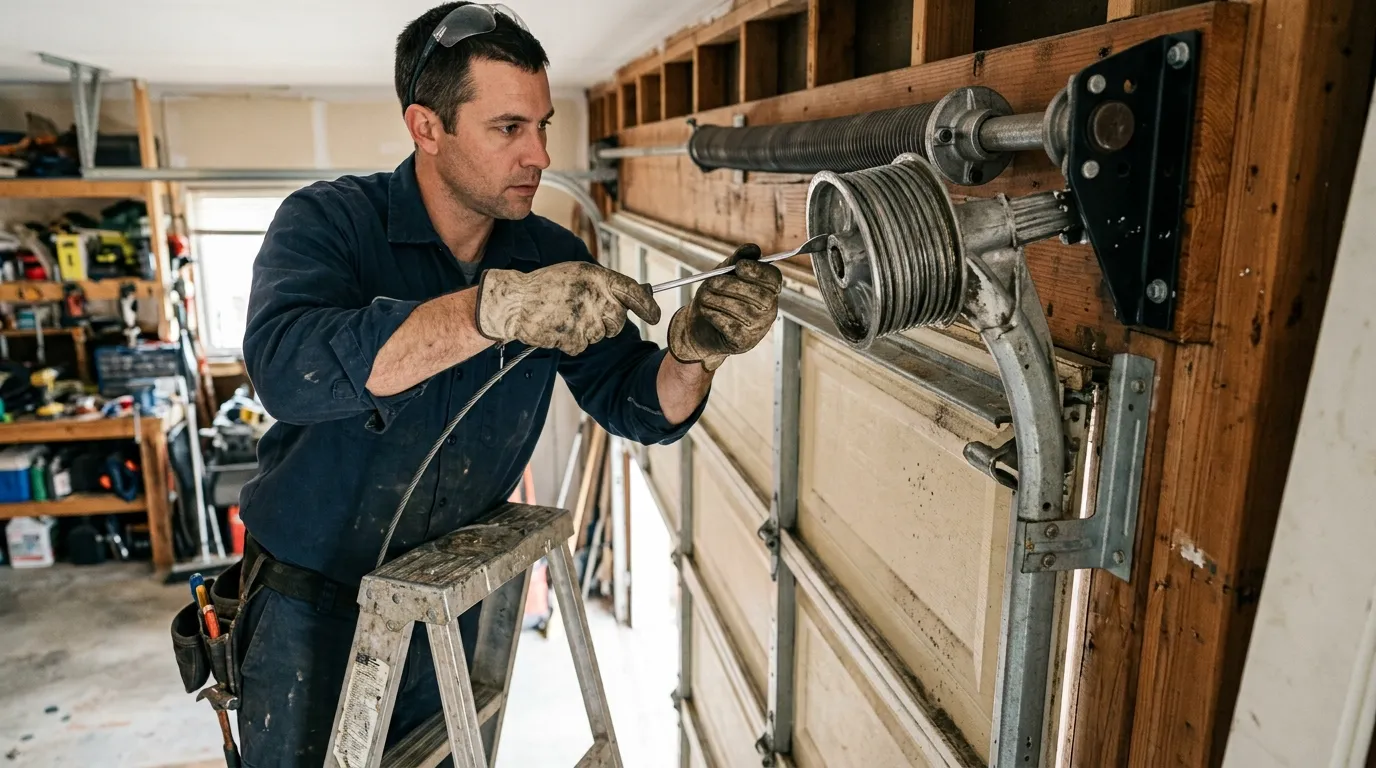
A broken torsion spring is not a Saturday project, and this isn't us being cautious for the sake of it. The spring on a standard door is wound with somewhere around 30 turns of stored tension, and the tools to safely unwind or wind it - winding bars, a proper ladder setup, clamps rated for the job - aren't things most homeowners own or want to own for a once-a-decade repair. On an older Pine Hills door, the extra wrinkle is that the drum, cable, and bearing plate have often never been replaced, so what looks like "just the spring" can turn into a bearing that's seized or a cable that's frayed at the drum. That's not a DIY diagnosis you want to make with the door half-open over your car.
What Can Go Wrong
On the older end of Pine Hills' stock, we see galvanized springs that have surface-rusted enough to shed coating and start pitting - that pitting is what starts the crack that eventually snaps the coil. We also see single-spring torsion setups on doors that really carry the load of two, because the door was heavier steel than what the original builder spec'd the spring for. Bearing plates on 1980-era track hardware are the other common failure point sitting right next to the spring, and if that bearing's frozen, replacing the spring alone doesn't fix the real problem - the door will bind again within months. We'll flag that on site rather than sell you a spring that won't hold.
What the Repair Takes
A standard torsion spring swap is most of the job: pull the old spring off the shaft, confirm the drum and cable are sound, install a correctly wound and sized replacement, and cycle the door a dozen times to check balance. On older Pine Hills doors we're also checking the bearing plate and center bracket while we're up there, since those parts are original as often as the spring is. If the door's steel gauge or track has warped from age rather than just the spring failing, that's a different conversation - sometimes the honest answer is that the door's due for replacement, not another spring, and we'll tell you that instead of just swapping parts.